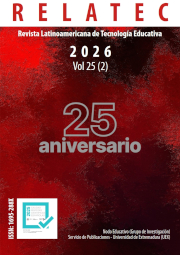
Twenty-five Years of RELATEC: Scientific Contribution and the Transformation of Educational Technology
DOI:
https://doi.org/10.17398/1695-288X.25.2.9Keywords:
RELATEC, Educational Technology, Open Science, Diamond Open Access, Scientific Journals, Generative Artificial Intelligence, Digital CompetenceAbstract
This article introduces the special section commemorating the 25th anniversary of the Latin American Journal of Educational Technology - RELATEC and reviews its contribution to the consolidation of Educational Technology in the Ibero-American context. First, it presents the journal’s editorial and thematic evolution since its foundation, highlighting its shift from early debates on ICT integration, e-learning, virtual platforms and multimedia materials to more complex issues related to digital competence, inclusion, digital citizenship, open science, open education and generative artificial intelligence. Second, it analyses RELATEC’s identity as a diamond open access journal, with no fees for authors or readers, and its alignment with the principles of bibliodiversity, transparency, knowledge reuse and public scholarly communication. Third, it examines the journal’s consolidation as a quality scientific publication, recognised by the FECYT Seal of Quality and indexed in evaluation and dissemination systems such as ESCI, DOAJ, ERIHPlus, Dialnet, Latindex and Journal Citation Reports. The article also presents the contributions included in the special section, coordinated by Manuel Area-Moreira and Bartolomé Rubia-Avi, and authored by leading scholars in the field of Educational Technology. Overall, the special section offers a critical reading of the current state of the field and outlines RELATEC’s main future challenges: internationalisation, open science, sustainability of the diamond model, methodological quality and responsible research assessment.
Downloads
References
Area-Moreira, M., Hernández-Rivero, V., & Sosa-Alonso, J.-J. (2016). Models of educational integration of ICTs in the classroom. Comunicar, 24(47), 79-87. https://doi.org/10.3916/C47-2016-08
Area-Moreira, M., Rodríguez-Rodríguez, J., Peirats-Chacón, J., & Santana-Bonilla, P. (2023). The Digital Transformation of Instructional Materials. Views and Practices of Teachers, Families and Editors. Technology, Knowledge and Learning, 28(4), 1661-1685. https://doi.org/10.1007/s10758-023-09664-8
García-Valcárcel Muñoz-Repiso, A., & Basilotta-Gómez-Pablos, V. (2017). Aprendizaje Basado en Proyectos (ABP): Evaluación desde la perspectiva de alumnos de Educación Primaria. Revista de Investigación Educativa, 35(1), 113-131. https://doi.org/10.6018/rie.35.1.246811
García-Valcárcel Muñoz-Repiso, A., & Caballero González, Y. A. (2019). Robótica para desarrollar el pensamiento computacional en Educación Infantil. Comunicar: Revista Científica de Comunicación y Educación, (59), 63-72.
Gewerc-Barujel, A., & Anguita-Martínez, R. (2025). Implicaciones, contradicciones y posibilidades de la ciencia abierta en España: El caso REUNI+D. Revista Latinoamericana de Tecnología Educativa - RELATEC, 24(2), 13-25. https://doi.org/10.17398/1695-288X.24.2.13
Gewerc-Barujel, A., & Ramos-Trasar, I. (2022). Mujeres y tecnología educativa en las universidades españolas. Los recovecos de la invisibilidad. Revista Latinoamericana de Tecnología Educativa - RELATEC, 21(2), 9-25. https://doi.org/10.17398/1695-288X.21.2.9
Gisbert Cervera, M., & Caena, F. (2022). Teachers’ digital competence for global teacher education. European Journal of Teacher Education, 45(4), 451-455. https://doi.org/10.1080/02619768.2022.2135855
Gisbert Cervera, M., González Martínez, J., & Esteve Mon, F. M. (2016). Competencia digital y competencia digital docente: Una panorámica sobre el estado de la cuestión. Revista Interuniversitaria de Investigación en Tecnología Educativa. https://doi.org/10.6018/riite2016/257631
Prendes, M. P. (2022). Formar para el emprendimiento digital: Construyendo los ciudadanos del siglo XXI. Revista Interuniversitaria de Investigación en Tecnología Educativa, 1-19. https://doi.org/10.6018/riite.525101
Prendes, M. P., Gutiérrez, I., & Martínez, F. (2018). Competencia digital: Una necesidad del profesorado universitario en el siglo XXI. Revista de Educación a Distancia (RED), (56). https://doi.org/10.6018/red/56/7
Rubia-Avi, B. (2022a). Los procesos de investigación en tecnología desde una la perspectiva mixta. RiiTE Revista interuniversitaria de investigación en Tecnología Educativa, (13), 80-92.
Rubia-Avi, B. (2022b). The Research of Educational Innovation: Perspective and Strategies. Education Sciences, 13(1), 26. https://doi.org/10.3390/educsci13010026
Salinas Ibáñez., J., De Benito Crosetti, B., Pérez Garcies, A., & Gisbert Cervera, M. (2017). Blended learning, más allá de la clase presencial. RIED. Revista Iberoamericana de Educación a Distancia, 21(1), 195. https://doi.org/10.5944/ried.21.1.18859
Salinas Ibáñez, J., & Marín Juarros, V. I. (2019). Metasíntesis cualitativa sobre colaboración científica e identidad digital académica en redes sociales. RIED-Revista Iberoamericana de Educación a Distancia, 22(2), 97-117. https://doi.org/10.5944/ried.22.2.23238
Zorrilla-Abascal, M. L. (2016). Transmedia intertextualities in educational media resources: The case of BBC Schools in the United Kingdom. New Media & Society, 18(11), 2629-2648. https://doi.org/10.1177/1461444815590140
Zorrilla-Abascal, M. L., & Castillo Díaz, M. (2023). Competencias de información y alfabetización digital en una licenciatura virtual. Apertura, 15(1). https://doi.org/10.32870/Ap.v15n1.2285
Downloads
Published
Issue
Section
License
Copyright (c) 2026 Jesús Valverde-Berrocoso

This work is licensed under a Creative Commons Attribution 4.0 International License.
Authors who publish in this journal accept the following conditions:
Authors retain copyright over their works and grant the journal the right of first publication. Articles are published under the Creative Commons Attribution 4.0 International License (CC BY 4.0), which allows third parties to share, copy, distribute, publicly communicate, adapt, transform, and reuse the work in any medium or format, including for commercial purposes, provided that authorship is properly acknowledged, the original source is cited, a link to the license is included, and any changes made are indicated. Note: This license applies to articles published from Vol. 25, No. 2, 2026 onwards.
Authors may enter into separate and additional contractual arrangements for the non-exclusive distribution of the published version of the article —for example, its deposit in an institutional repository or its subsequent inclusion in a book—, provided that it is clearly stated that the work was first published in this journal.
Authors are permitted and encouraged to deposit and disseminate their work on the Internet, for example, in institutional repositories, institutional websites, or personal websites before, during, and after the review and publication process, as this may foster scholarly exchange, increase the visibility of the work, and enable broader and faster dissemination of the published research.