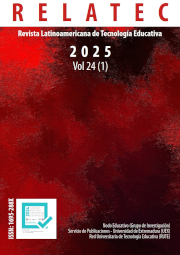
RELATEC VOL. 24 Nª 1
DOI:
https://doi.org/10.17398/1695-288X.24.1.125Keywords:
Educational TechnologyAbstract
Complete journal
Downloads
References
Vázquez-Cano, E., Fombona, J., Morales-Cevallos, M. B., & López-Meneses, E. (2025). Analysis of the Impact of Using a Gamified App for Spanish Spelling Practice in Primary Education (Análisis del impacto del uso de una aplicación gamificada para la práctica de la ortografía en español en Educación Primaria ). Revista Latinoamericana de Tecnología Educativa - RELATEC, 24(1), 9-28. https://doi.org/10.17398/1695-288X.24.1.9
Berríos-Barra, L., & Calderón-López, M. (2025). Analysis of Pedagogical-Digital Competence in Teacher Educators: Practices and Perceptions (Análisis de la competencia didáctico-digital en formadores de futuros docentes: Prácticas y percepciones). Revista Latinoamericana de Tecnología Educativa - RELATEC, 24(1), 29-47. https://doi.org/10.17398/1695-288X.24.1.29
Cepa-Rodríguez, E., & Lancha-Villamayor, V. (2025). Digital Competence among Teacher Training Master’s Degree Students: Differences by Gender, Age, and Field of Study (Competencia Digital en alumnado del Máster de Formación de Profesorado. Diferencias con base en el género, la edad y la especialización). Revista Latinoamericana de Tecnología Educativa - RELATEC, 24(1), 49-64. https://doi.org/10.17398/1695-288X.24.1.49
Albalá-Genol, M. Á., Etchezahar, E., Gómez-Yepes, T., & Ungaretti, J. (2025). Phubbing as a Social Norm: Effects on Fear of Missing Out (FoMO) and Perceived Exclusion (El phubbing como norma social: Efectos en el ‘miedo a perderse algo’ (FoMO) y la exclusión percibida). Revista Latinoamericana de Tecnología Educativa - RELATEC, 24(1), 65-75. https://doi.org/10.17398/1695-288X.24.1.65
Dubarbie-Fernández, L., Barreras, Á., & Oller-Marcén, A. M. (2025). The Use of GeoGebra in Teaching Mathematical Concepts: Practices, Barriers, and Teachers’ Perceptions (El uso de GeoGebra en la enseñanza de conceptos matemáticos: Prácticas, barreras y percepciones docentes). Revista Latinoamericana de Tecnología Educativa - RELATEC, 24(1), 77-100. https://doi.org/10.17398/1695-288X.24.1.77
Cuenca-Rodríguez, M. E., Pascual-Moltó, I., & Pastor-Prada, R. (2025). Digital technologies in music education. Using Digital Audio Workstations (DAW) with Project-Based Learning (PBL) (Tecnologías digitales en la educación musical. El uso de DAW - Estaciones de Trabajo de Audio Digital con ABP - Aprendizaje Basado en Proyectos). Revista Latinoamericana de Tecnología Educativa - RELATEC, 24(1), 101-117. https://doi.org/10.17398/1695-288X.24.1.101
Downloads
Published
Versions
- 2025-01-02 (2)
- 2025-01-02 (1)
Issue
Section
License

This work is licensed under a Creative Commons Attribution-NonCommercial-NoDerivatives 4.0 International License.
Authors who publish in this journal accept the following conditions:
Authors retain copyright over their works and grant the journal the right of first publication. Articles are published under the Creative Commons Attribution 4.0 International License (CC BY 4.0), which allows third parties to share, copy, distribute, publicly communicate, adapt, transform, and reuse the work in any medium or format, including for commercial purposes, provided that authorship is properly acknowledged, the original source is cited, a link to the license is included, and any changes made are indicated. Note: This license applies to articles published from Vol. 25, No. 2, 2026 onwards.
Authors may enter into separate and additional contractual arrangements for the non-exclusive distribution of the published version of the article —for example, its deposit in an institutional repository or its subsequent inclusion in a book—, provided that it is clearly stated that the work was first published in this journal.
Authors are permitted and encouraged to deposit and disseminate their work on the Internet, for example, in institutional repositories, institutional websites, or personal websites before, during, and after the review and publication process, as this may foster scholarly exchange, increase the visibility of the work, and enable broader and faster dissemination of the published research.